The Gulf Plays Defense
Omar Rahman on the changing shape of the Middle East
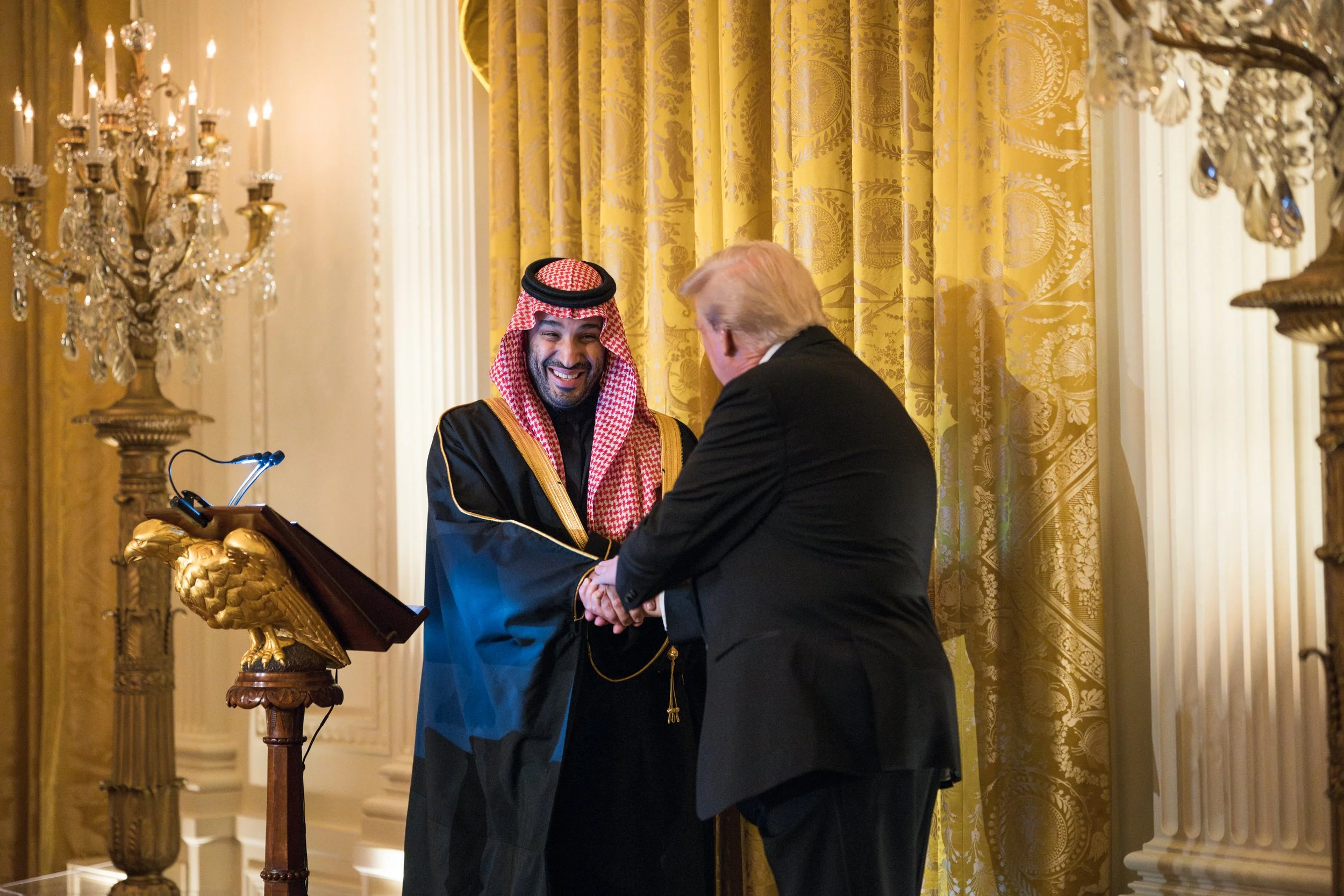
The wealthy countries of the Persian Gulf have steadily become some of the United States’ closest partners, through investment, technology, and military relationships. But Israel’s assault on Gaza and US-Israeli attacks against Iran have brought turbulence to the region. Now targeted by Iran, the Gulf states find themselves stuck in the middle of a conflict they did not choose.
In this episode, the Institute for Global Affairs’ Jonathan Guyer is joined by Omar Rahman, a fellow at the Middle East Council on Global Affairs. Together they discuss how different Gulf states are navigating the current conflict with Iran, the state of the Abraham Accords, and Trump’s Board of Peace. Omar also explains where Palestine fits into the picture and how a lack of legitimate leadership is holding Palestinian liberation back.
Listen Here: Apple Podcasts | Google Play | Libsyn | Radio Public | Soundcloud | Spotify | TuneIn | RSS
Omar H. Rahman is a fellow at the Middle East Council on Global Affairs, where he is the editor of Afkār, an online publication focused on Palestine, Middle East geopolitics, and US foreign policy. He previously served as a nonresident fellow at the Baker Institute for Public Policy, a visiting fellow at the Brookings Doha Center, and a research analyst at the Arab Gulf States Institute. Omar started his career in journalism, working for publications including +972 Magazine, World Politics Review, and Argus Media. His writing has been published in The Washington Post, Foreign Policy, The Guardian, and Rolling Stone, among others.
Find Omar on X: https://x.com/omarrahman
Read his recent article in Foreign Policy: https://foreignpolicy.com/2026/04/07/iran-united-states-gulf-uae-qatar-bahrain-saudi-oman-war/
Transcript:
JONATHAN GUYER: Welcome to None Of The Above. I'm your host, Jonathan Guyer. America and Israel's war with Iran has created a multitude of new crises in the Middle East. Today we're going to take a closer look at that region, particularly the Arab Gulf states, and how they're navigating all of this. My guest is Omar Rahman, a fellow at the Middle East Council on Global Affairs, and one of the most astute analysts of the Middle East in Washington.
We discuss the differing motivations of Gulf states throughout this crisis, the meaning of the Abraham Accords with Israel, and the role of Arab public opinion throughout. And although much of the attention here is focused on Iran, Palestine very much remains top of mind. We get into the future of Palestinian leadership, how Trump's Board of Peace is working out, and much more.
Thanks for listening. I hope you enjoy the conversation.
GUYER: Omar, welcome to None of the Above.
OMAR RAHMAN: Thanks so much for having me, Jonathan.
GUYER: So, you focus a lot on the Gulf—I don't know, Persian Gulf, Arab Gulf. We can argue about which Gulf. It's definitely not the Gulf of America yet, but the Gulf. And I think the war in Iran, the war against Iran, has revealed some new things about the Gulf. What has jumped out to you? You've been doing a lot of writing about this, but what are the kind of what are your key takeaways about how all these small Arab Gulf states are reacting to this momentous war that's kind of totally changed the way they see the world?
RAHMAN: Yeah, I mean it's certainly been, I think, an inflection point for the Gulf. In a sense, a nightmare scenario, something that they were worried about, dreaded for a long time, maybe never thought would materialize, and here it's come to their doorstep, despite I think a pretty robust attempt to prevent the war when it was building in the months ahead of time. And so I think that's been a shocker and there's been a period of adjustment. And I think that initial period looked like a sort of rallying together—exactly. I think the six Gulf Cooperation Council states came together, were helping each other out, and so they were responding together to kind of the immediate outbreak of the war and Iran's decision to incorporate them in its battle plans, right?
GUYER: And this was like the strike on obviously on the UAE, on Qatar, on just sort of... they got thrown into this war.
RAHMAN: Yeah, I mean it was across the board. I think every single Gulf state was affected, some more than others. Obviously, the UAE has borne the majority of the brunt. The US military bases in Kuwait and Bahrain have been hit very hard. But all the states together have been affected by this. And basically, Iran was both responding to the fact that that military architecture exists, but it was also using these states as an area or a territory to retaliate and escalate, right? So when the US and Israel were escalating against Iranian targets inside of Iran, hitting civilian infrastructure, Iran would retaliate against those states and hit their infrastructure. And so that's how Iran responded and how it basically achieved escalation parity with the United States and Israel. And obviously its closure of the Strait of Hormuz, which was intended to kind of regionalize and globalize the effects and the consequences of this and the costs of the war going on.
GUYER: So where do you see these different Gulf cooperation states standing now? Because there was a moment where it felt like they were a hundred percent aligned and very defensively focused, but then they each have kind of carved out their own worldview of this moment. And I'm thinking about how the UAE has pulled out of OPEC+, which is sort of interesting. Not a security pact but still, it kind of reflects this going their own way. Could you kind of map out for us where you see all these different countries at the moment?
RAHMAN: Yeah, I think before we got into this ceasefire—which I think took effect April 8th if I'm not mistaken—even before that happened, the war was settling into a sort of attrition between the sides. And I think at that point we started seeing these states trying to navigate it in their own ways, right? Or their approaches to navigating this war started to be distinct. And you had certain states that were very cautious, did not want any semblance of entry into the war, were working diplomatically to bring it to an end, and did not want to engage in a way that would escalate their involvement in any way. Qatar, Oman I think fit that profile. At the same time—
GUYER: And they’ve been the mediators in a way too.
RAHMAN: And a long time, because their relationship with Iran is a bit different than their counterparts in the Gulf. I mean, with Oman you have a long-standing historical relationship between these two sides. And when it comes to Qatar, Qatar shares the largest natural gas field in the world with Iran. And therefore, it's had to have a very strong and working relationship with Iran over time. But the UAE, which was being hit hard, wanted to be much more assertive in basically trying to re-establish its deterrence. And there were other states doing that as well.
We've seen reporting that that suggests that Saudi Arabia was also involved in strikes on Iran. But at the same time, it approached that from the kind of like, telegraphing that to Iran directly as almost sort of symbolic strikes. Much like we saw Iran—it's hard to even imagine this now at this point, but if you can remember back in 2024, the first time Iran sent volleys of strikes against Israel, it telegraphed them like week ahead of time so that Israel could intercept them all, right? It worked with other parties like the Gulf states to basically telegraph its intentions so that there wouldn't be an escalation. It would just allow Iran to respond. So we've seen Saudi Arabia take that approach in the middle of this war.
Anyway, getting back to the point, in the ceasefire, and even prior to that, I think there was also a set of strategic calculations that these states were making and they were approaching those differently. And again, the Gulf Cooperation Council, people think of it as a kind of united block. And in ways, that architecture is there. But these states are rarely acting in that fashion. And as you mentioned, the UAE's decision to pull out of OPEC+ is part of that. I mean, the way they described it as well, they did it in very diplomatic terms, but they also said we're putting a strong emphasis on our strategic autonomy. So that would show you that they have their own intentions and way of going about things in the future.
GUYER: And these strikes that—again, this is based on reporting that Saudi Arabia has launched some strikes on Iran. And have the Emirates as well? Is there some reporting there? I mean, this is kind of a fascinating escalation that these were kind of seen as countries that had a kind of cold economic peace with this shared waterway, the Strait of Hormuz. And now it's not just one direction in terms of these strikes.
RAHMAN: Yeah, initially you were hearing officials—this was right around the time of the ceasefire—you were hearing officials on the Emirati side saying that they were essentially interested in taking a more active or sort of role in the war. And then it was later reported by the Wall Street Journal and others that indeed at that moment, like right around the when the ceasefire was being negotiated, they did strike Iran in a number of places. And so again, that's what the reporting is saying. I haven't heard that officially confirmed by the Emirati government but that's the reporting that's out there.
GUYER: Maybe you could give us a kind of bigger picture landscape of the Gulf Cooperation Council, because I think you hear it thrown around a lot, probably in Washington, the GCC, and that's become so important in the context of artificial intelligence investment and all sorts of next generation financial institutions being based in these countries. But what is the GCC and what isn't the GCC? I mean, what does the GCC actually do?
RAHMAN: Yeah, it is a little confusing. It's a multilateral institution that's made up of six states, all situated along the Gulf within the Arabian Peninsula. You have—
GUYER: They have a lot in common, yeah?
RAHMAN: They have lot in common. They also have meaningful differences between them, which explain, again, the differences in their approaches. But you have Saudi Arabia, which is almost the outlier state. It's huge geographically, it's 20 million people. All the other five states are very small, both territorially and demographically. So when you're talking Kuwait and you're talking the UAE, these are roughly one million, 1.5 million citizens, much larger populations of expatriate workers that are within their territories. And that I think is a characteristic broadly shared among the Gulf Cooperation Council states. But it's the case that in some of these states, the expatriate workers far outnumber, maybe nine, ten to one in some states. So the UAE and Kuwait are small. Qatar and Bahrain are a few hundred thousand citizens. But enormously wealthy states, obviously. And Oman, which is I think the larger of those five, I think it's around three million citizens, give or take, and a little bit of a larger territory. So that's that.
And the Gulf Cooperation Council, was founded in 1981, largely in response to some of the crises that were happening in the region at the time, which is the 1979 Iranian revolution, the outbreak of war between Iran and Iraq in 1980. And so these states decided to come together in a more institutional framework. I think in 1984 they established the Peninsular Shield, which is supposed to be an integrated military force, but never came to fruition in that sense. So a lot of the projects, economic projects, a desire to have a single currency, economic union, a lot of that stuff has never really materialized because these states have... they work well together in some senses and in other senses they don't. And there are deep seated rivalries. And these are kind of monarchic systems, dynastic systems, in which there I think there's, the long memories for ruling families and slights can last a generation, maybe. So you have these kinds of elements at play, I think, as well.
GUYER: What do you make of, I think Steven Cook of the Council on Foreign Relations is making this argument, that this is the new center of gravity in the Middle East. That Cairo, Damascus, Beirut, and this is an argument that's been being developed over a decade or more, as after the Arab Spring and after civil wars, those countries have faced real dire financial straits. And the Gulf Cooperation countries, in a large way, have been underwriting those economies. But have these GCC countries kind of replaced the center of gravity in the Middle East? I mean, we don't hear about the Arab League all that much anymore, but we do often hear about the GCC.
RAHMAN: No, I think that's a true way of describing it. I mean, this was the kind of economic center of the region for quite a long time. Obviously these are major exporters of energy. They have huge sovereign wealth funds, they're players in global markets. But in more recent years or more recent decades, you've seen the kind of the center of political gravity shift towards the Gulf as opposed to states like Egypt or Iraq. As those states have gone through their own instability, political turbulence, economic problems, you've seen power shift. And especially during the Arab Spring period, 2010, 2011, and its aftermath, you saw the Gulf states be much more assertive within the regional space as other states were going through these kind of turbulent moments politically, even militarily, civil wars and all that kind of stuff. You saw these Gulf states take a much more active role. And trying to either shape outcomes that were beneficial to themselves or seek stability, so there were there were a number of different goals motivating them.
But one of the things you actually saw here was again the Gulf states not acting in unison, right? And you saw competing camps or competing blocks between let's say Qatar and Turkey on one hand, Saudi Arabia and the UAE on another, and Israel there somewhere, and Iran there somewhere, and the United States. And so you saw competing blocs basically fighting it out, maybe not militarily, but strategically in a lot of these spaces from Syria, Yemen and all different kinds of places, Libya.
GUYER: It's a valuable point because it gave the illusion of a kind of unity, let's say, between the United Arab Emirates and Saudi Arabia, because in a lot of the political transitions and Arab Spring revolutions, they were on the same side, but they weren't on the same side on every issue. And I think now we're seeing those fissures between Mohammed bin Salman, Crown Prince of Saudi Arabia, and then the leadership of the United Arab Emirates. But it maybe wasn't always readily apparent in those geopolitical moments a decade or decade and a half ago.
RAHMAN: Yeah, I think you have shifting alignments here and clearly the one that's obvious or was obvious right before the war between Saudi Arabia and the UAE, which you just mentioned. But previously those two states were very closely aligned on a lot of these issues, and Qatar was the kind of odd man out within the GCC. That culminated in 2017 in a kind of a rupture in relations in a blockade imposed by Qatar's neighbors that lasted until 2021.
Another element of this, again, is the kind of the relationship to Israel and the Abraham Accords, which—
GUYER: Wanted to bring this up, so yeah, exactly.
RAHMAN: Well, it's important because 1) it springs out of this period, right? And 2) it has led us in some ways to the place we are right now in the war that is engulfing the region. And I say that because to me, and I've written a lot of book chapters, papers, articles on normalization dating back to even a year and a half or two years prior to the Abraham Accords being signed and looking at what was motivating them, and then later, kind of looking at the weaknesses underlying those.
But one of the motivations was, again, you had this regional environment in which you had these coalitions of states that were competing very intensely in a lot of these areas. And there was a profound sense, I think, of vulnerability that some of these Gulf states experienced and their sense of threats were inflamed. And so I think part of that, part of the motivation, let's say for the UAE, for example, or for Israel, is a desire to counter mutually perceived threats in the region. And the major one in that context was Iran, from let's say the UAE and Saudi's point of view, along with the Israeli side. And so I think there are other motivations, maybe even more important motivations, when it comes to the Gulf relationship with the United States and the desire to reinforce that relationship at a time where a lot of Gulf states feared their relationship with the United States maybe was unraveling or what was underpinning that relationship in terms of oil, security, all that kind of stuff, was kind of coming apart as the US was becoming a greater producer.
GUYER: I think we should pause for a second and get a little more deeply into the Abraham Accords because you did write that paper that you alluded to for the Baker Center at University of Texas. Is that right?
RAHMAN: Yeah, that was one of them. I think that was like the third or fourth.
GUYER: Maybe you could tell us because I'm sure listeners of None Of The Above know all about these normalization agreements between Israel—starting with United Arab Emirates, Bahrain, Morocco, Sudan never really happened—and this is at the end of Trump's first term and became a policy the Biden administration adopted and is likely seen as a huge priority of this Trump term, despite the fact that it ain't going nowhere. But tell us, what is your... you have a kind of novel analysis of it almost? So why don't you break it down for us a little bit on how you saw these agreements at the time and how they've evolved, because I think they've totally thrown aside Palestinians and the Palestinian state, but they reveal something about US power and how Gulf states conduct foreign policy.
RAHMAN: Yeah, I think it's complex, so I'll try to do it as succinctly as I can. But again, I think it came out of that threat environment at the time and the desire to reinforce the relationship with the US. But I described it at the time as not an exercise in peacebuilding, but an exercise in coalition-building for that reason, right? That these states, let's say the UAE and Saudi Arabia and Israel, were never at war with each other. They didn't have relations, but they had never gone to war with each other. They had never fought.
At the same time, the worst kept secret in the Middle East was that these Gulf states had clandestine relations with Israel, security and intelligence relations with Israel. So essentially what you did was formalize a relationship. Why they did that, what motivated them to go from kind of a secret relationship to a formalized relationship is a matter of a number of interests, but there was the motivation to essentially make it formal and publicize it and make it more concrete. And again, when I was writing that Baker paper, it was about the weaknesses underlying that.
And one of the core weaknesses, in my opinion, is that again, when you're creating a coalition to confront and contain a country like Iran, for example, alongside the Trump policy of maximum pressure on Iran, which was working in tandem with this kind of coalition-building that was happening in the region, Iran was perceiving that as a threat and tensions were ratcheting up. And so pretty quickly, I think, Iran sent signals to the Gulf states through the form of attacks, both direct and through proxies, on Saudi Arabia in 2019 at the Abqaiq oil facility and Khurais oil facilities, which shut down fifty percent of Saudi Arabia's oil production.
GUYER: And totally shocked the Gulf and shocked Saudi Arabia.
RAHMAN: Yeah. And then there were attacks on the waterways and on UAE infrastructure as well. And I mean, one message was look, you guys are vulnerable and we will attack you. But the larger message was the US response or really the failure of the US to respond in a robust way. And so the Gulf states realized that in a confrontation with Iran, their security is not guaranteed by the United States. It's not this kind of foolproof security envelope for them. And therefore, they moved pretty quickly at that point to recognize that in a confrontation with Iran, they're on the front lines. Which is what we're seeing today, right? And so they moved to kind of establish a rapprochement with Iran, a detente with Iran, and to try to neutralize themselves in that potential confrontation that was building. And in the end, I mean we've gotten to this point where the US has moved with Israel hoping that the Gulf states would come along, but they didn't. And yet the steps that the Gulf states took to inure themselves to Iranian attacks didn't really work out.
GUYER: We’ve jumped ahead a little bit, and I do want to get into the gap between maybe what the Gulf states that normalized relations with Israel thought they were doing versus where they've ended up today. But it seems like the major elephant in the room is Palestine and the fact that Palestinians were left behind by these agreements. I mean, the UAE did do this normalization accord with Israel under the pretense of not having settlement expansion or de facto or de jure annexation of the West Bank. However, that sort of has gone ahead in a lot of ways. But I guess why I bring this up is it seems like there are meaningful differences, if subtle, between Gulf states on Palestine and in particular on Gaza since 2023. Maybe you can give us the lay of the land there because... or maybe there aren't meaningful differences. How do you see it?
RAHMAN: No, sure. And I definitely jumped ahead. I think there was a belief among those states that moved ahead with relations with Israel that the kind of taboo regarding having open relations with Israel while the Israeli occupation of Palestine and the colonization of Palestinian territories was continuing had become less severe, that they could move ahead with relations with Israel without costs. And I believed even at the time that that was a mistaken approach. At least, I mean they were right in the sense that it didn't blow up immediately in their faces, but the context in which that was not permissible but they could get away with doing it was something that was shifting. It wasn't permanent. You know, the conflict between Israelis and Palestinians at the moment was sort of on a low boil at that point. The issues around the Arab Spring and the turmoil that engulfed the region had kind of shifted the focus away from Palestine.
And so I think there was the impression that they could move forward in relations with Israel without much blowback. And again, in a sense, they did. I mean, there was no condemnation in the Arab League when Egypt signed a peace treaty with Israel in in 1979, in which Egypt was kicked out of the Arab League for a decade. The League is based in Cairo and continued to be, right? But Egypt, their membership was suspended. So we didn't see any of that type of thing happening. At the same time, the Oslo Accords framework and this type of relationship and what existed on the ground in the Palestinian territories between Israel and the Palestinians was changing. I think that era was coming to an end, and the era in which apartheid was being recognized globally as existing within the occupied territories. And and now we've gotten to the point where a genocide has taken place openly in the Gaza strip, and yet the relationship between Israel and the UAE and Bahrain is holding, but the costs that are associated, which were always there, the cost of this relationship in terms of kind of image and public perception, which would be a constant drain on those normalizing countries, I think has grown much greater over time.
GUYER: One of the biggest questions I've had, and I've posed it to senior Gulf officials, including from the United Arab Emirates, is what would it take for you to break off relations with Israel? Is there any scenario in which the situation goes too far in Gaza, in the West Bank, in other situations?
RAHMAN: What did you hear?
GUYER: You know, these answers were not given on the record, but the the answers that I received are “not exactly,” “not really,” “nothing's going to change.” I mean, they're so sewn up together. And I think part of this is a function of the United States as the kind of arbiter of these agreements. And has received some benefits. I do think there have been some US auxiliary benefits. But as you say, a lot of this is formalizing a status quo that already existed. So yeah, how do you see it?
RAHMAN: Again, I think a strategic decision was made by the UAE and Bahrain to get into this relationship. And that was not a light decision, one that would be broken easily. Now, if what's happened in Gaza and what's happened since wouldn't lead to the unraveling of their relationship, I don't know what would, because we’ve kind of seen a worst-case scenario. It’s not just the occupation ongoing for six, seven decades. Something catastrophic has happened in Gaza and it's happening in the West Bank and yet there's been no real change in the relationship.
GUYER: Does public opinion matter in the Gulf? I mean, we were looking into how to poll the Gulf, and it's pretty difficult when these countries are at war, so it's very limited. But there are some public opinion polls, and even in countries that don't have democratic freedoms and don't have elected leadership, public opinion can still really impact this moment. How do you see that?
RAHMAN: There is public opinion, but again, you're right. It's hard to gauge in terms of the polling numbers. You don't really know how accurate they are.
GUYER: How frank people want to be.
RAHMAN: Yeah, and free speech and kind of criticism of government is not something that happens freely across the Gulf. Somebody asked me the other day, an Iranian scholar that I was having lunch with, asked me what's the Gulf street like at the moment, right?
GUYER: Great question, yeah.
RAHMAN: And I was like, the concept of the street doesn't really apply to the Gulf in the traditional sense, right? Like people don't go out into the street to protest. That's what we talk about when we talk about the street and their grievances being aired openly, right? What I said is that there's no Gulf street, but there's the majlis, right? These are the kind of salons that citizens have in which issues are discussed privately, right? And there are public ones as well, you know, there's the Emiri Diwan and this kind of stuff. So official business is done in those kinds of places. But officials, sheikhs, even just private citizens have places where people come and socialize and discussions are had in private spaces in that way. And that's where that kind of stuff, I think, in terms of public opinion and the public attitude and mood may bubble up and affect decision making, policy making.
GUYER: I'm glad you brought up the majlis because it does reflect this kind of consultative coalition-building, this kind of... it's very old school, it's somewhat patriarchal, it's hierarchical, but it's still coming together as a community to talk through issues, to share how people really feel. And I wonder what is someone like Mohammed bin Salman, the crown prince of Saudi Arabia, who's so associated with disruption... do those spaces still exist to the same extent or have they been replaced by this new public sphere of malls and cinemas and so forth, in places like Saudi Arabia?
RAHMAN: No, I think they still exist. Again, how much they're relied upon by any particular leader is another story. But those consultative spaces exist. Just to mention as an aside, Kuwait also has—it's a little bit different and this is goes back to the first questions we were talking about—it has a parliament that's fairly robust, which is the difference from other Gulf states and it can be a constraining factor on the government and government decision making. The UAE, for example, doesn't have that, and you really have kind of a very centralized top-down decision making that happens in the country. I think Saudi Arabia was in the past quite different from that. I think that may have shifted under Mohammed bin Salman, the crown prince, and so these kinds of things differ across the Gulf and how much weight they're given.
GUYER: Well and Kuwait historically is one of the more pro-Palestine advocates in this GCC context. And I guess that kind of connects to the parliament and kind of the voice of the people there.
RAHMAN: Yeah, there's a long-standing history with the Palestinian diaspora there, which was uprooted after the first Gulf War because of some of the positions of the PLO, but prior to that and the kind of Arab nationalism and intellectual elite that existed within Kuwait. So there's a long history of that. But yes, there's a more functional, robust parliament and therefore kind of civic space that exists in Kuwait that might not exist in some of the other countries. And the policy regarding Israel and regarding the Palestinians in Kuwait reflects that. Again, it's more, let's say, receptive or responsive to popular will and public opinion. And they said at the time they would be the last state to normalize with Israel of the Gulf states, Kuwait did. And that's something that's been upheld by the emir that succeeded the previous one. So again, I think the more top-down decision-making states you're going to see more willingness maybe to take those type of risks or to engage in what it believes are its own strategic interests of the family, of the state, as opposed to some states that might have to be more responsive to their citizens and public opinion.
GUYER: Let's get a little more focused on Palestine, because you're also an expert on that, Omar. What do you see as your assessment of this generation of leadership? Who are the leaders after Mahmoud Abbas, who has been head of the PLO since Arafat essentially? The situation in Gaza is obviously abysmal, and the leadership of Hamas has obviously been assassinated or largely gone underground. So, who are the next generation of Palestinian leaders?
RAHMAN: That's a good question.
GUYER: Deep sigh.
RAHMAN: Yeah, yeah.
GUYER: We need a new generation of leaders, but I don't want to fall into this kind of cliche that there needs to be a Palestinian Gandhi. I want to kind of get to the bottom of who are the voices that are coming through this.
RAHMAN: Yeah, let's not do that. Well I—and I keep speaking about papers I've written—the latest thing I've published is a paper on the leadership crisis pre and post October 7 among the Palestinians and kind of a diagnosis of what's happened there. But the short answer is there is no next generation of leaders ready to take the helm. And that is because there's been a steadily eroding political space among the in the Palestinian body politic. And that's a result of, I think, the failures of the Oslo Accords and the impact it's had on Palestinian politics, but also the monopolization of power and decision making by one man in the West Bank, Mahmoud Abbas, who's at the same time the president of the Palestinian Authority, the president of the state of Palestine, the head of the Fatah party, the chairman of the PLO. So holding multiple hats, maintaining control and slowly, steadily and forcibly consolidating his power over decision-making.
And then you had a fracture that happened in 2007 between the West Bank and Gaza and Hamas in control of the Gaza strip. And it also being different in terms of the structure of Hamas relative to Fatah and Abu Mazen and his control. Definitely more of a robust institution itself, Hamas is, that kind of produces leadership and produces ideas and all that kind of stuff. But authoritarian nonetheless in its control over the Gaza strip. And so you don't have an electoral means of regenerating leadership, ideas, vision, any of these kind of things, because there has been no elections in the occupied territories since 2006. Not for president since 2005. So 2006 was for the parliament, which been liquidated by or dissolved by the president in 2018, right? And so it no longer functions. So you basically don't have a means for contestation.
And when a glimmer of that occurred back in 2021, if I'm not mistaken, and elections looked like they were going to be held because Trump came out of office, Biden came into office, and I think Mahmoud Abbas wanted to ingratiate himself with Biden and show that he had democratic legitimacy. And so he was going to host and hold an election, and there was an agreement between him and Hamas to do so. When the Biden administration showed no interest in that happening, in my opinion, then those were quickly shut down. But in that short amount of space, a few months, that existed, you had dozens of party lists that were formed, overcoming huge obstacles that were put in place to prevent them from happening. You know, in terms of the age of the people, how many signatures they needed, the amount of money they had to deposit—all these things were put in the way and yet you had this flourishing of democratic activity among the populace that was desperate for a voice and a new direction. And then it was shut down and clamped down, and we haven't seen anything since on that front.
Although elections are starting to happen again, but now they've been kind of stripped of any validity by the ruling parties. And so yeah, that's the space we're in. Let me say one more thing actually, and that is that in his consolidation of control over power, he has basically orchestrated a succession of process. Basically, he's kind of handpicked a possible successor that has no legitimacy whatsoever and no popular support whatsoever, a man named Hussein al-Sheikh, to kind of take over for him. And he's just put his own son into a position of power within the Fatah party as well. And there are all types of reasons and corruption issues underlying that, but that's essentially where we are among Palestinians.
GUYER: What about Marwan Barghouti, who is in Israeli prison, long seen as someone who has legitimacy in leadership of someone like Yasser Arafat, who has kind of been on a political journey himself, but then is also viewed by Israelis as a terrorist. And there's all these anecdotes that come out of his lawyer not even being able to visit him for months at a time, that he's been abused in prison and faced pretty horrible tactics against him. Is he someone who represents a different political path forward for Palestinians at this moment?
RAHMAN: Well, what he definitely represents is legitimacy and popular support. So again, there aren't a lot of names out there, but among the names that are out there, he is kind of a consensus pick and people support him. Again, he's been in prison for over twenty years. So I pointed to what has happened on the Palestinian side that has prevented new leadership from emerging and new ideas. But the Israelis have had an active role in that for a very long time, for decades and decades, in terms of assassinating Palestinian leaders, imprisoning them like they have done with Marwan Barghouti on trumped-up charges. This was a political show trial rather than a criminal one. And various policies that were put in place.
And actually, one of the largest—and this is I think something that's owned both by the Israeli side and the Palestinian side, and I've seen an interview with one of the architects of Oslo in which he said, one of our core conditions was that the leadership of the PLO would come into the occupied territories, right? I think that's something that was probably wanted by the PLO leadership at the time as well. But to me, it was a strategic mistake, right? Because you recentered Palestinian decision making and leadership under Israeli occupation, where it became extremely vulnerable to Israeli coercive pressures, financial pressures, and the like. And therefore, since that point, you really haven't seen independent Palestinian decision making. Which was always pressured because the Palestinians don't have a state of their own. And so, the Palestinian national movement or the liberation movement was always hosted in various states in the region and came under the coercive pressures of other Arab states, but never to the degree that we've seen from the Israeli occupation since 1994 and the return of the PLO.
GUYER: It raises an interesting question, which is can those new Palestinian voices, the next generation of leaders, can they come from the diaspora? Not that I'm looking at you, but could there be some folks that are beginning this conversation? I mean, there's such a vibrant world of journalism, of publishing, of ideas, of academia, basically in every field Palestinians are thriving in diaspora in just about every country. Where does that lead in the occupied territories and so forth? I guess that's a bit of a tough open-ended question, but I do see some kind of hope there, despite the tragedy that has faced so many Palestinians under occupation.
RAHMAN: It's an important question. I would say two things. First of all, there are also lots of capable, energetic people in the occupied territories themselves. The problem is again, no pathway to leadership roles and a campaign from the power structures to kind of demobilize and suppress those types of people. So that's one thing. Obviously, there's more space in the diaspora and you definitely see energetic activity organization that's happening. The problem is it's mostly at the civil society level and it's fragmented by its own nature. It hasn't mobilized as a political alternative to what exists internally. There's been attempts at that somewhat but Palestinians are very resistant to fragmentation. It's something they've had to deal with since 1948. The fragmentation geographically, politically, in many ways that it has been imposed upon them. And therefore, there's an attempt not to have that type of fragmentation.
It's occurred, obviously. It's occurred between Hamas and Fatah, for example, and between other parties and other type of things. But I think when we're talking about the diaspora leadership, there is no leadership, right? There are people and there's institutions, but there's no kind of recognized leadership that has coalesced or established itself. And so you see a lot of things happening. You see activity like the BDS movement, which is an important and effective tool, I think, in waging a political campaign, or not a political campaign but a pressure campaign, I think, against Israel globally. But at the same time, there is not a corresponding united political leadership inside or outside that is guiding those kinds of efforts, right? And without that, I think it's really taken a lot of the kind of momentum and force out of what's happening within the diaspora, sadly. So I think the most important thing that needs to happen right now for the Palestinians is to establish a unified, legitimate representative leadership that can in turn set forth a kind of a vision and a strategy for Palestinian liberation.
And so in the absence of that, we're seeing a lot of things happening legally, within the legal space internationally. You're seeing a huge amount of international support at the popular level for Palestinians. All these things are being cultivated and mobilized, but without a real direction that's maximizing the effectiveness of it.
GUYER: So where does the Board of Peace fit into all this? This kind of new Trump mechanism. I think it's the most under covered institution in Trump's second term relative to its importance. It feels like it doesn't get the kind of attention it deserves, what it actually represents in terms of whether it's diplomatic corruption or the vast sums of money that are or not in its coffers. But it does have this kind of Gaza executive committee, and it has a group of some Palestinians and international leaders on it and a bunch of Trump administration officials. What's your sense of the Board of Peace? What is it up to?
RAHMAN: God, where do I start? I think it feels to me like everything everywhere all at once at the moment. And so what's happening in Gaza is tragically being under covered or overshadowed by what’s happening in Iran and elsewhere.
GUYER: And it's ongoing.
RAHMAN: Yes, that's what I mean. It is. But there was a twenty point plan established and an agreement, and these institutions like the Board of Peace that were established to have a role. And anybody with knowledge of what's happening on the ground looked at all of this with a massive amount of skepticism that this would produce any results. But at the same time, the alternative that was happening at the time was a full-on genocide in live view with hundreds of people being killed every day, people starving to death, and so there was very little alternative then to this pathway through the Board of Peace.
And at the same time, I think, again, there are so many problems with it. I don't even know where to begin. But I think a fundamental one is Trump, and this is something the Israelis, I think, understand about Trump, is he has very little attention span that he devotes to anything. You can establish these types of things, and although the Israelis I don't think wanted to see a ceasefire put in place in his plan, at the same time I think they knew who they were dealing with and that they could channel the outcome of this in any direction they saw or they wanted.
And we've seen Netanyahu in the last few days, I think, give some type of interview in which he said, well we've already taken over sixty percent of the Gaza Strip and we're aiming now for seventy percent of the Gaza Strip. And you're seeing people being killed every day. And none of the obligations that were put on Israel as part of this framework have been met at all, in terms of the free flow of aid, and allowing people to kind of come and go, and reconstruction happening, and so none of that happened.
GUYER: There’s so much that hasn’t happened.
RAHMAN: Yeah. And the Board of Peace is not doing anything, right? And Israel is getting its way. The one Palestinian aspect to that structure that was devised was this kind of committee essentially that would kind of execute things on the ground. And Israel hasn't even allowed them to step foot into Gaza, right? And so Israel's really calling the shots here and Trump's not doing anything about it. And therefore, this whole enterprise is floundering and the Board of Peace—nobody's given it money, so it's not even functioning.
And something that's really gone underreported is apparently the Trump administration has tried to—stepping back for a second. Israel withholds tax money that it collects on behalf of the Palestinian Authority that at this point is in the billions of dollars. And it's sitting in Israeli banks under Israeli control. And they've done this for years and years. Now, part of the Oslo Accords is Israel has the right to collect Palestinian export and import taxes and a number of other things on behalf of the Palestinians, and it's supposed to transfer that to the Palestinian Authority. It often withholds it as a form of coercive financial pressure over the Palestinian Authority. And at the moment, because this ultra-right-wing government is really trying to collapse the Palestinian Authority, it's withheld that money for a very long time. And so it's accumulated a significant amount of funds. And now Trump is talking about maybe taking that to fund the Board of Peace, right? So it's just, I mean, the amount of corruption and cynicism here, taking this money away also from... this is just theft. The Israelis were already engaged in theft and here's the White House also wanting to engage in theft.
GUYER: Well, there's a kind of co-optation, it seems, on a lot of levels. There's a co-optation of the World Bank as part of it, using it as a bypass for the financial aspects of it. There's the co-optation of the United Nations that, I think there was a Security Council resolution that brought the Board of Peace into existence, so it has some kind of shell of legitimacy. And then of course the fact that they've brought in these various world leaders to give it a semblance of structure. But in actual fact, as I understand it, and this is largely reporting I think from the Financial Times, the Tony Blair Institute is doing a lot of this work. So it's essentially been outsourced.
RAHMAN: Yeah. I mean, if you go look at the kind of the money trail and the paper trail that led to the creation of this architecture that Trump has put into place, it leads to Tony Blair and his institution and Jared Kushner and what he's been trying to do for years. And so, really the people devising this have their own ulterior motives, I think. And it's just been very unfortunate that the international community has given into Trump and his pressure. But I remember his ambassador at the United Nations sitting there at the Security Council saying, either the Security Council endorses this or we're going to green light Israel going back to bombing Gaza, right? And so this ultimatum was ultimately put over the international community that, accept our dictates and our plans, even though they're kind of illegal under international law as I understand it, or we’ll allow Israel to continue just massacring Palestinians at a faster clip. And again, the killing is still going, and the starvation is still going, but...
GUYER: Yeah, you'd think at bare minimum, and this is a very low minimum considering the stakes and how war crimes and so forth have unfolded, that at least necessary medical assistance and food aid and so forth that has long been promised would get into the occupied territory of Gaza and it still hasn't.
RAHMAN: Yeah. I expected it to and it hasn't. You're saying the lowest rung of this ladder has not been met or hasn't been reached. And again, I think that's because Israel wants it that way. And the Trump administration has proved itself unwilling to push back on Israeli plans.
GUYER: Where do you see this going in terms of—we've just done some new polling as IGA showing that Americans are pretty critical of arms sales and arms transfers to Israel, that opinion towards Israel has changed. This mirrors a lot of other polls. I think it's a majority of Democrats, and especially young Democrats, do use that word: genocide. That still is very much a taboo among politicians and very few, with the exception of the mayor of New York, Zohran Mamdani, would use that word. Do you see that wave of change in US public opinion having an effect on US foreign policy in the short or medium term? Or it's still going to be a massive gap between what Americans think and believe, and what policymakers are doing with respect to the Middle East?
RAHMAN: Yeah, it's a great question. Obviously, we have seen that sea change in public opinion, not just in the United States but globally. But certainly, I think, most dramatically and importantly inside of the United States. And it's not just happening on the Democratic side or on the progressive side anymore. It's kind of across the political spectrum, maybe with one demographic exception inside the United States, and I think that's really important. Now, are we going to see that translate into policy? I'm more reserved on that assessment. I'd love to see it happen immediately in November. But again, the political system in the United States has also changed quite a bit. You know, we're living in the plutocratic age, I've heard it described, or the oligarchic age. That type of money and its effect on politics means more than public opinion in a major way.
My hope is that we're on a trajectory here that is hopefully irreversible and that will impact policy. And again, you're seeing it already. I don't want to like totally downplay things because we've seen, even in this Congress, even in this Senate, votes being taken recently on sending arms and military equipment to Israel, and you're seeing even died in the wool supporters of Israel take a stand in opposition to that. And so there are changes happening, and you can't evade public opinion completely on this issue because it'll come back to bite you. But I want to just be a little cautious in our assessments as well.
GUYER: So just to bring it all back to kind of the core question, and I think you pose it really well in a recent article of yours for the Middle East Council of Global Affairs think tank where you work: can Trump escape from a negotiation trap of his own making? I mean, it is totally the fastest moving news cycle of Middle East war that I've ever followed. And as an analyst, I feel like I'm going on TV or radio and checking the news right before to see if there's a new ceasefire, a new deal, or a new strike, or a new outbreak of conflict, even as it's just moving so quickly. So do you think the president can escape this trap? I mean, is he stuck in his own maximalist approach?
RAHMAN: It's a good question.
GUYER: It’s your question, that’s why it’s good.
RAHMAN: I'll try not to trap myself too closely to the news cycle, but what I meant by negotiation trap of his own making is essentially a number of decisions Donald Trump has made over the years has put him in an almost impossible situation in terms of negotiating a deal with Iran. And one of those, or maybe the primary one, was his decision to pull out of Obama's nuclear deal, the JCPOA, in 2018. And in doing so, he framed it as the worst agreement ever and that he would do better, right? And so what I was saying was he basically set, with that, a political baseline where he couldn't negotiate a worse deal than the JCPOA or else it would be seen as a failure. I mean, it's hard to evade that, right? And therefore, he's got to negotiate a better deal.
Now he's started this war in which he's actually empowered Iran in ways that it was never empowered in peacetime. He's handed Iran leverage like they've never had at any moment maybe in their history, in the sense of yes, he's degraded Iran, but by unleashing the Iranian military on the region and its control over the Strait of Hormuz, Iran now has an incredible amount of leverage. And therefore, can Trump negotiate a better deal than Obama had negotiated in the past? At the same time, he has hollowed out American institutions like the State Department, so people that negotiated the Iranian nuclear agreement and the experts that were in place are no longer there anymore. Even in the Defense Department and the military, the generals, and all this stuff. Forty generals have been fired at the highest levels.
So Trump is relying for diplomacy on his handpicked loyalists like Jared Kushner and Steve Witkoff, who are incapable of negotiating this type of detailed agreement with the Iranians. They've proven that. And so I think Trump is coming out of this from at a very difficult position, both structurally and then also politically, because he started a war of choice without consulting the American people, without consulting the American Congress, without consulting American allies. And therefore, he's trying to sell a war in order to end it, which I do believe he wants to end it. He's trying to sell it as a victory. But it's very difficult because the anti-war camp in the United States is not going to let him sell it as a victory. The Democrats are going to call this a failure no matter what. The anti-war Republicans, like your Tucker Carlsons and all of those, want this to be a cautionary tale in military adventurism, which they are against. And the pro-war camp, both on the left and the right in the US, the hawks, want him to go in there and finish the job. They don't want this war to end, especially on the terms in which he's now discussing them vis-a-vis the Iranians.
And so I think you have a very difficult, and we've kind of seen this in terms of how this is all playing out with the “memorandum of understanding,” which should be the easiest thing to negotiate. Not that it's going to be easy, but easy in the sense of it's a non-detailed, narrow document just kind of establishing what we're going to negotiate and some basic terms. It's not the detailed agreement that needs to be signed on the nuclear program down the road. It's not negotiating the exact terms of whether Iran is going to control the Strait of Hormuz or the ballistic missile program or...
GUYER: The table setting access.
RAHMAN: Yes, exactly. And so there are a lot of things that need to be done and I don't believe Trump is capable of really negotiating the same type of deal or a better deal than Obama had. And if he doesn't do that, it's just going to be this failure that he's trying to avoid at home. And so I think at the end of the day, if a memorandum is agreed to, I don't think we're going to get to the second part of that in which things are... I think it's more likely that he kind of steps away and hopes people forget about this before the November election and that whatever agreement he comes to with the Iranians on the Strait of Hormuz leads to a settling or stabilization of the US and global economy. And I think that's what Trump is trying to achieve here, but he's finding it very difficult for all the reasons I named.
GUYER: Omar, thank you for your analysis. Thank you for joining us and we'll keep reading you. Thanks for being on None Of The Above.
RAHMAN: Thanks so much for having me. I really had a good time.
GUYER: Thank you, Omar, for joining me on this episode. None Of The Above is a podcast from the Institute for Global Affairs at Eurasia Group. Eloise Cassier is our producer. I'm your host, Jonathan Guyer. Thank you to our team: Lucas Robinson and Ransom Miller.
If you enjoyed what you heard, please rate and review us on Apple Podcasts, Spotify, or wherever you're listening. And if you haven't already, please subscribe to the show so you don't miss an episode. As always, we welcome your comments and questions: info@noneoftheabovepodcast.org. Til next time, many thanks for tuning in.