Food for Geopolitical Thought
Anny Gaul on the history of the tomato in Egypt and what it can teach us about global foodways
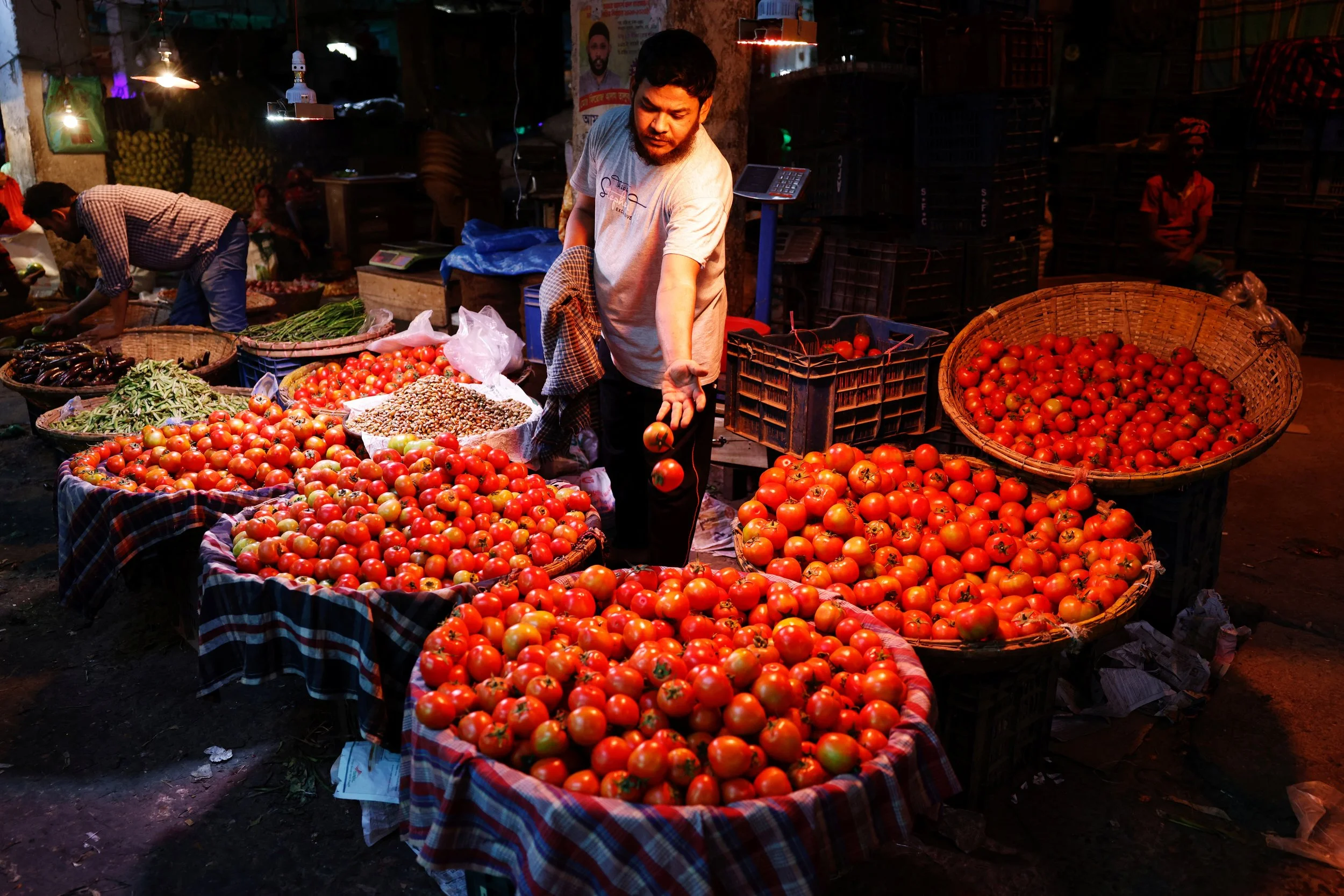
Food doesn’t often enter conversations about foreign policy, but it is integral to it. Our relationship to food shapes ideas of identity and nationalism and is continuously impacted by the forces of history. Technological, social, and political changes inform and alter global foodways over time. And in today’s interconnected world, food supply chains are inextricable from geopolitics.
In this episode, the Institute for Global Affairs’ Jonathan Guyer is joined by Anny Gaul, a cultural historian and professor of Arabic studies at the University of Maryland, to explore the geopolitics of food in the Middle East. They discuss Anny’s new book, Nile Nightshade: An Egyptian Culinary History of the Tomato, and how global events both shape and are informed by one of our most basic forms of sustenance.
Listen Here: Apple Podcasts | Google Play | Libsyn | Radio Public | Soundcloud | Spotify | TuneIn | RSS
Anny Gaul is a cultural historian, professor of Arabic studies at the University of Maryland, and author of the food blog Cooking with Gaul. She is the author of Nile Nightshade: An Egyptian Culinary History of the Tomato (University of California Press, 2025) and co-editor of Making Levantine Cuisine: Modern Foodways of the Eastern Mediterranean (University of Texas Press, 2022). Her writing has appeared in Foreign Policy, The Nation, and Eater.
Check out Nile Nightshade: https://www.ucpress.edu/books/nile-nightshade/paper
Read an excerpt of the book in Foreign Policy: https://foreignpolicy.com/2025/11/07/egypt-tomato-price-food-agriculture-culinary-history/
Find Anny on X: https://x.com/annygaul
Transcript:
JONATHAN GUYER: Welcome back to another episode of None of the Above. I'm your host, Jonathan Guyer. On today's episode, we discuss the politics of food. I'm very excited to welcome my friend Anny Gaul to discuss her new book, Nile Nightshade: An Egyptian Culinary History of the Tomato. Anny is a cultural historian of the modern Middle East. She's a professor of Arabic studies at the University of Maryland and writes the blog Cooking with Gaul.
She is also co-editor of the book Making Levantine Cuisine: Modern Foodways of the Eastern Mediterranean. Today we explore the relationship between food and identity, how it can help us understand geopolitics, and of course, we talk quite a bit about tomatoes. And with that, let's get to it. Thanks for listening.
Anny Gaul, welcome to None of the Above. We're so glad to have you here.
ANNY GAUL: Thanks so much for having me. It's great to be here.
GUYER: I want to talk about your first monograph today, Nile Nightshade. It's just come out. It's an exploration of the history of the tomato in Egypt. And it's a pretty fascinating book, actually, about the geopolitics of food, because the tomato doesn't come from the Middle East. It doesn't come from the Mediterranean. It comes from Mexico. Could you set us in this book of sort of how you came to be studying the tomato in Egypt and what is the meaning of the tomato in Egypt?
GAUL: Sure. Well, thanks so much for having me. It's great to be here and to talk about the book. I did not set out to write a book about the tomato. I am a food historian. I work on North Africa very broadly. So I had done a lot of research on the history of the modern kitchen in — I compared Egypt with Morocco as part of my doctoral research. Particularly in Egypt, the tomato emerged again and again as this cornerstone of the modern cuisine. But of course, as you say, it is originally from Mexico, it was introduced at some point. But it's become completely ubiquitous.
So, when I was thinking about a book project, I wanted a sort of through line, a really coherent story to tell. And the tomato just emerged as a natural vehicle for basically telling a story of modern Egyptian food history, but also of the modern Egyptian food system, of modern agriculture in Egypt, and I think of modern Egypt in general, in a way that's different from looking at the government sort of top-down histories or other ways of thinking about the history. I had a lot of research about cultures of consumption and cuisine and the way that tomato became so important to all different parts of Egyptian cuisine. And as I was writing the book, I did a lot of additional research into the production of tomatoes, so agricultural history and the way, as you say, it's really a book about Egypt that doesn't stop at the borders of Egypt. And that has to do with culinary influence and, of course, all the different cultures that have influenced Egyptian cuisine, but also, of course, the sort of more political economy, the fertilizer that fertilizes tomatoes, the capital that financed dams that provide the irrigation that tomatoes need, and of course the tomato itself comes from outside of Egypt.
And so it was a way to tell a very sort of globally oriented history of Egypt and hopefully contest the way we often also tell histories in these national frameworks. So it helps us get beyond that in a lot of different ways.
GUYER: I love this line you have — how in Egypt you could be eating tomatoes morning to night, breakfast, lunch, and dinner. And it's sort of remarkable, just on a material level, that this is not a product that comes from Egypt. It's pretty new. You trace different recipes that are sort of seen, kosher-y, the grain bowl, or shakshuka, other dishes that are sort of so core to foodways in the Middle East or in Egypt. And the tomato is relatively new.
GAUL: Yeah, the tomato finds its way into traditional home cooking, into street foods, into foods that have been prepared a particular way in Egypt for hundreds of years, and then it becomes a new way of adding acidity to a dish, for example. And then what I found in my research, which was also interesting, is that it became equally prominent in Egyptian horticulture. So most of Egyptian agriculture is focused on the big cash crops — cotton, wheat, rice, and so forth. But within the realm of horticulture, which is fruits and vegetables, the tomato becomes totally dominant really early, by the 1930s. And Egypt today is one of the top 10 producers of tomatoes in the world. What distinguishes it from a lot of other top tomato producers is that they consume almost all the tomatoes that they grow. So it completely transforms not just the kitchen, but also horticulture and just what it looks like to grow fruits and vegetables or to sell fruits and vegetables and so forth. And so that shows up also in statistics and agricultural manuals, but also popular culture and all kinds of other places as well.
GUYER: So we go way back. We lived in Cairo at the same time and spent a lot of time in book markets together, kind of looking through archives in search of new ways to study modern and contemporary history. Tell us about your research methods here, because this is not a conventional set of texts. You're drawing on cookbooks and recipes and oral histories, and how do you tell this modern history of the tomato? What are your sources here?
GAUL: There's a great tradition of historians of Egypt going to the used book markets in Cairo, and some in Alexandria as well, for sources. And that's partly to do with what is and isn't in libraries, what is in archives, which parts of archives researchers are allowed to access, and so forth. So the genesis of this project really began in the book market, in the used book market, where I was wandering around asking for sources on food. I knew I was interested in that, and it was from the booksellers at the Ezbekiya market in Cairo that I learned about Abla Nazira, who is this iconic mid-century Egyptian cookbook author. And so that's where things begin.
GUYER: Tell us a bit about her. She is kind of the model homemaker in a way?
GAUL: Exactly. She becomes a household name. She publishes a series of cookbooks, but her first cookbook comes out in the early 1940s, and she was actually trained in England. So in the 1920s.
GUYER: And you went to England, right?
GAUL: I also went to England. Exactly. So I begin with this cookbook that she wrote, which I find in a used book market, and I actually learned that her book was one of a whole genre. There was a whole generation of Egyptian women writing modern cookbooks at this time. Part of what's special about her cookbook is that it includes a lot of documentation of different regional dishes in Egypt, as well as a ton of European food, French food in particular. So that reflects her training. She studies domestic science and cookery in the UK. She learns all the French mother sauces, all these sort of European refined approaches to cuisine. And then she comes back and writes textbooks and cookbooks and trains other domestic science teachers. Domestic science, sort of what we would call home economics.
GUYER: I want to linger on that because you actually talk about this a little in the introduction to your book, the double meaning of domestic, and how scholars have talked about this. And look, this is a bit academic for our public policy-focused podcast. But I thought it was so cool that domestic both has this home economy meaning, but it also kind of alludes to domestic politics and the domestic nature of a society. And there's a lot of double entendres in your book that kind of explore these things that are very personal, very home-based, and then also have this societal-level dimension. So one thing I'm thinking is the creation of the modern kitchen as we know it in Egypt — it kind of happens on a similar timeline to what you're talking about with this author, Abla Nazira, is that right?
GAUL: Yeah, so she is writing for a new kind of figure, an educated woman. So women are being educated in increasing numbers in Egypt at the time that she's writing, in the '40s, '50s, and '60s, and she's writing for a new kitchen. At the time she's writing, it's largely a theoretical kitchen for most Egyptians, but the idea that you have running water, you have a gas stove, you have a refrigerator. And the point about domestic that I make — and American studies scholars have pointed out that domestic means both what happens inside the home, but of course what happens inside national borders. And I think what food does so beautifully is it connects those two and shows how intricately linked they are.
And I think one of the goals of the book, and the intervention that I'm hoping to make to people who think about food policy or food systems more broadly, is the importance of domestic practices, of domestic culture, of these things that we might think of as completely separate from policy concerns. When you look at food, you see that you actually can't really understand food systems, you can't build a just or a functional food system without understanding food culture and domestic culture. And so that's kind of a through line. And you mentioned the modern kitchen — I mean, this is completely tied up with a shift towards the use of kerosene and petrol and oil, right?
GUYER: All these changes of industrialization, of people moving to cities from the countryside into Cairo or Alexandria.
GAUL: And people start to cook differently. So they're cooking over kerosene instead of over coals or fire. And the government plays a huge role in facilitating that transition. It completely changes the way that people cook, but it's also, of course, tied to the policy of the country, how it's provisioning its people — not just with bread, famously, but also with the fuel that people expect to cook with in a particular way.
GUYER: So this is also a bit academic, technical, but I think it's really important. Can you unpack for us what you mean by "culinary publics"? This is sort of how you analyze and think about these changes as through culinary publics. Talk us through that.
GAUL: Yeah, so I wanted a way to talk about the communities that food creates, this sense of belonging, this sense of connectedness that wasn't just bound to either the nation or the state, because those things have limitations and exclusions. So, I settled on "the public" and "a culinary public" as an idea. And the book deals with a lot of different culinary publics. So in each chapter it's quite different. In a chapter about cookbooks, for example, I'm talking about a reading public that's quite narrow. But in the chapter about tomato prices, I'm talking about a much broader sense of how Egyptians related to each other, connected through food. And specifically the example I give is the price of tomatoes.
GUYER: You have a great excerpt in Foreign Policy magazine on this — about "the crazy tomatoes," and here it's about the price, right? That it's so unstable in this time of, I guess, economic liberalization in Egypt, and prices are fluctuating. So tell us about the crazy tomatoes.
GAUL: Yes. So the traditional street cry, if you're a street vendor out in the street in a city in Egypt and you're selling tomatoes, what you say is "magnuna ya oota," which means "crazy tomatoes" in Egyptian, spoken, colloquial Arabic.
GUYER: So you hear this and you're thinking, I need to understand how this relates to the tomato in Egypt.
GAUL: And it's just understood, if you speak to Egyptians, that that is a reference to tomatoes' volatile prices. So tomatoes are this, as we've talked about, really important part of everyday cooking, and every kind of dish you can think of comes to potentially incorporate a tomato. And so their supply is obviously very important, but their prices fluctuate. This is notable specifically in Egypt because of how it contrasts with the price of bread. So since the 1940s, since the World War II period, bread has been subsidized by the state to grant citizens access to cheap wheat bread. So the price of bread does not change very much. It was the same from the late '80s until 2024, the price of a loaf. They did shrink the loaf, but they kept the price the same, right? So that's a very important — the price of bread is a really symbolically important piece of food policy, I guess is what I'm saying.
If you contrast that to tomatoes, tomatoes are not controlled by the state in terms of production or pricing, as important as they are, and their prices fluctuate for all kinds of reasons. There are seasonal variations, so the supply is different year-round — even though Egypt can grow tomatoes year-round, unlike most places, different regions grow tomatoes in different seasons, right? And they're at different quantities. So that affects prices. Tomatoes are very delicate fruits and they often spoil on the way to the market, depending on how far they're traveling and what happens to them along the way. And then there was this notorious group of merchants at the wholesale market in Cairo for most of the 20th century that essentially set their own prices and would manipulate prices for profit. So for all these different reasons, as important as tomatoes were, their prices could double from one day to the next, and they rose steadily over the course of the 20th century.
Every time I go back to Egypt, you have a conversation about the price of tomatoes with whomever. And everybody sort of knows and tracks this, and it's a sort of barometer of how expensive life is. So I find it really interesting, that tomatoes are so important and yet not regulated. I think it really tells you something about how food policy priorities are set, based on subsistence and calories and sort of carbohydrate staples. Maybe to some extent on protein, but things like tomatoes that bring flavor and different expressions of what dishes can be — those aren't subsidized in the same way. The prices aren't controlled in the same way
So it's interesting to think about what we prioritize, in terms of providing a public — to go back to this concept of the public. What does the public expect? What do they complain about? So I basically read this food cry as an example of a collective complaint that people make. And I argue Egyptians are participating in some kind of public. In order to complain about the price of tomatoes collectively, and for everyone to understand that, it's also telling us something about what Egyptian people expect of their government, of their leaders. They're making a moral demand on their leaders. They're calling out — the prices of tomatoes are crazy, this isn't right. So I think there is also — something else I try to do with the book is show that there's actually quite a lot of political critique embedded in popular culture, in films, in street cries, in poetry, in songs and sayings and that kind of thing. There's actually a lot to be learned about what a people, a public, thinks about their government.
GUYER: It just strikes me that food is actually so important to politics in Egypt, which is at least 90 million people, this hugely central country in the Arab world and the Middle East. And when there was an uprising in 2011, one of the main protest cries was "bread, freedom, and social justice." And bread is never just bread — it's subsistence, it's livelihood...
GAUL: It has symbolic meaning, right.
GUYER: Right. And as you say, it's deeply connected to the state and how the state supports working-class, lower-class people who can't afford staples in their diet. What else did you come across? You said films were a big part. What other kind of unconventional sources did you find yourself grasping for to tell the story of how the tomato is so important to Egypt?
GAUL: So there's one film I analyze, El-Fetiwwah, made in 1957, which focuses on corruption.
GUYER: The Thug, right?
GAUL: Yes, exactly. In English it would be called "the thug" or "the bully," it's sometimes translated as. And it's basically about this group of tomato merchants who colluded to drive prices up and were part of the reason for the tomatoes' quote-unquote crazy prices. The film made a huge impact when it was released. The main corrupt merchant, the villain of the film, was based on a real person who actually sued the filmmaker for defamation and tried to stop the film from being produced. All of which is to say — it went on, and it was screened, and the lawsuit failed. But that's to say that Egyptian audiences saw this film and recognized their own reality — it was reflecting reality back to them. And my reading of the film is that, ultimately, it places the blame on the corrupt government officials that enable the merchants. Because at the end of the film, there's a suggestion that if you get rid of one merchant, another one will come. The problem is the system, the problem is the state. And so it has this critique of the state — what is the expectation that the state will provide to its people?
During the Nasser period: social justice, and extending the good life — a middle-class life, access to food, access to gas stoves and refrigerators — was a key part of the primary ideology of the government and its promises to the people. So you can read that in something like a film, something like a protest slogan. So you mentioned the 2011 revolution — in the late 1970s, there was also an uprising, often called the Bread Intifadas, when, in response to IMF pressure, Sadat, the president at the time, said that he was going to reduce subsidies on a number of things, including bread. And for two days, people protested all over the country. And a lot of the protest chants that come out during that period mention bread, they mention meat, right? These are goods that people expect from the government. So that's one example of a source. There's colloquial poetry, satirical poetry I talk about, where it's not just bread — you then start to get vegetable metaphors.
And so this goes to my point about popular culture — food as a way to read political critique — because there are a couple of vegetables, zucchini, squash, okra, whose names show up in colloquial sayings, colloquial poetry, going back as far as the nineteen twenties, as synonyms for corruption. So even after the 2011 revolution, there was this saying: if the Nile River were made of salsa, were made of tomato paste, there still wouldn't be enough to cook all of the zucchini in Egypt — zucchini meaning corruption. And so there's this sort of running commentary about the state through conversations about food that happen. And this is just how people talk in everyday life. This isn't novels or sort of capital-C culture — this is just in the fabric of Egyptian society.
GUYER: Tell us a bit about how you see Middle East food in the United States and also in New York. It just came to the top of my head — Zohran Mamdani, the new mayor, his first viral video was about lowering the price of halal carts, these iconic food carts in New York, largely run by Egyptians. And food has been so central to his public image. The restaurants he chooses often reflect places he loves in his neighborhood, but there are also South Asian cuisines, places that he wants to uplift, that he wants to highlight the workers of, he visits them. But it's sort of amazing to think that the politics of food has been so central to this new young millennial mayor who's shaking up politics.
GAUL: I think that speaks to maybe a generational trend, a generational moment. I think it's not an accident that as a millennial I had a food blog, and then that became the focus of my research. And I think that the politics of restaurants, and the politics of how restaurants are categorized or named, is something that is very of the moment. So I think we can see that resonate with his politics. But of course there's also this question of labor. People are, maybe particularly since the COVID-19 pandemic began, really attentive to: okay, well, who is working in the kitchens? Those are conversations that I think are happening in ways that maybe haven't before.
GUYER: And where the food comes from, which is another side of that. You have the labor side of serving or creating, and then—
GAUL: Sourcing, absolutely, which, with climate change, is becoming even more important. I will say, too — something that one of the chapters in Making Levantine Cuisine, this edited volume, addresses, is this question of: what is Mediterranean food? And when is "Mediterranean food" used as a label that actually papers over or softens the politics of Lebanese food, Palestinian food? Something that's really exciting right now — this is happening in Washington, DC, where I live, and I think it's happening in New York as well — is more of an embrace of calling a restaurant "Palestinian food," of claiming that, of not softening it, not shying away from calling something Syrian or Palestinian. It does change a narrative to insist — we reject the notion that these place names have to be associated with violence, with occupation, with civil war. We can also use those names to talk about food in a way that's completely different from what it was 25 years ago. There have been Palestinians, Lebanese, Syrians moving to this country since the late nineteenth century. Many of them opened restaurants, and a lot of those restaurants were called "Mediterranean" or these sort of euphemistic names. And I think that's really changing right now, which I think is a positive thing.
GUYER: A couple years ago, I guess now, I did a story for The Guardian about this Egyptian-Palestinian restaurateur who was hosting a Shabbat dinner, a solidarity Sabbath dinner, for Jews, Muslims, Christians, Arabs, and so forth. And it was inclusive, it was free for the whole neighborhood. There was a line down the block. And it was a pretty remarkable scene for someone who's proudly hosting a Shabbos dinner at a Palestinian restaurant. I mean, these sites have been very political. There's a funny line in your book where you're kind of — it's a truism, everyone knows food is political. It's so obvious to food scholars, but maybe to the general public, it's not always so obvious how political food is.
GAUL: Yeah, or it's not always obvious what exactly we mean by that. And I think sometimes you can say "food is political" as an excuse to not talk about things. But to your example, to insist you can use the word "Palestinian," you can say this is a Palestinian restaurant hosting a Shabbos dinner — that doesn't need to be a contradiction. You don't have to water it down by calling it Middle Eastern or Mediterranean, or falling back on, well, we all eat the same food, and therefore we can paper over political differences. But if you can use it as a way to talk more frankly, and to get into — well, why is it as important to use a particular label or category, or to have a conversation in a different way? I think that's an opening to something different.
GUYER: Well, and you talk about too how the nationalism of food is exclusionary. It sets these limits on — and not just Israeli food, but that's become one of the flashpoints, I think, especially among activists — Palestinians and Israelis claiming many foods that are historically from—
GAUL: Have rich histories in all kinds of places, including Palestine.
GUYER: And then dishes like shakshuka, to come back to, which is sort of Tunisian, but then gets recast in many different cultures. I guess your task is to trace it. It's hard to trace a lot of these foods.
GAUL: Yeah, and a lot of them — I mean, shakshuka is one that linguistically we can trace, that word coming from a North African dialect of Arabic. And there are histories to these. It's not to say that only Tunisians can eat shakshuka or can make it, but I think it's important to trace and acknowledge what are the lines of those histories and how did they come to be. How did Tunisian shakshuka end up in Egypt? What were the connections between those places? We might not think of Egypt as part of the rest of North Africa, but there were all kinds of connections — trade connections, pilgrimage connections, traveler connections — that brought dishes across North Africa, for example.
GUYER: One thing, and maybe I'm projecting here, but we came into Arabic studies and studying Arabic at a similar time. And for me, it was very shaped by this post-9/11 moment where the Middle East, the Arab world, the Muslim world was cast in the security lens, the terrorism lens. And we had to – us VS them – we had to understand this whole notion of a Middle East that is put in conflict with the United States. And I feel like what your work, at least how I see it, does is really subverts this, and avoid these high-level security, international relations questions, but get to a lot of the similar answers. You're talking about ideology, you're talking about the role of the state, you're talking about all the nuances of political life and geopolitics of Egypt and the Levant and the broader Middle East, but it's through this surprising method and this surprising subject matter.
GAUL: Yeah, I think that security, war-on-terror lens, which is the lens with which so much of the United States views the Arabic-speaking world, it relies on collapsing a lot of complexity into stereotypes. It requires ignoring history. There's a lot of sort of willful ignorance that comes along with that framing. And so by bringing in these everyday details of what food looks like from the inside out, from the inside of a home outwards, from people's everyday lives, the hope is to push back against those narratives. And this is something I do a lot in my teaching, trying to get students to understand the diversity of the Arabic-speaking world. So the question of cooking fuel emerges completely differently in Egypt and Morocco.
In Egypt, there's a shift to oil-based, kerosene cooking, and then gas cooking, much, much earlier than in Morocco. So then the question is why? Development happens really differently. French colonial policy in Morocco incentivizes very different things from what British policy in Egypt is incentivizing. So it's a way to sort of not just connect people's actual everyday lives to these bigger political questions, but also to show that nothing in this region is inevitable. You cannot assume anything about it based on what you think you know. Processes are not going to unfold the same way in every place. I would say another huge area that, in my writing and in my teaching, I really push back against in terms of this framing is gender in the region. This assumption that women are oppressed, the women are all the same — they're absolutely not. I have oral histories with women who love cooking and talk about cooking. I have some oral histories with women who hate cooking, right? Not everybody is the perfect housewife. It seems like such a simple thing to say, but to actually put those details into print and to talk about them.
GUYER: One thing you mentioned is how some of the original cookbooks were for men — chefs at banquet halls or more official functions — versus the home chefs, who didn't really have cookbooks. It was passed on through oral history, is that right?
GAUL: Exactly. A lot of the culinary knowledge was, and still is, passed on through oral practices, embodied practices, and so forth. And so the first generation of print cookbooks in Egypt was all written by and for men. So the idea of a cookbook for women — we might look at it and say, perhaps that's just promoting the idea that the place of the woman is in the home. But if you look at the actual cookbooks, they are presenting themselves as scientific texts. They are assuming an educated audience, right? It speaks to valuing education, it speaks to an expectation that there are going to be women readers who can read formal Arabic, which you need an education to do. And so when you look at a gender history, a very different picture emerges of what you might otherwise assume or encounter.
GUYER: Anny, I want to ask you a question that I know you've thought a lot about. If we look at a map of the Middle East, there's a certain line where people eat rice and others where people eat couscous. Talk us through the geopolitics of couscous versus rice, and why one is so popular in Egypt and one is so popular in Morocco, these two places you've studied in depth.
GAUL: Yeah, the couscous-rice divide. This is, of course, an oversimplification, but looking at what people's staple carbohydrate is can tell you a lot. Just to take couscous — it's made from semolina, it's made from durum wheat. It can be made from a lot of things, but often it's made from durum wheat. And the word itself, and the technique for making it, is very, very old.
It goes back in North Africa to before the Arab invasion. This is an Amazigh, or indigenous North African, way of eating. What's quite interesting about the history of couscous is that with the Arabization of North Africa—
GUYER: Which is, ballpark, what year?
GAUL: We're talking between the ninth and thirteenth centuries, which is also the time when people start writing cookbooks in Arabic. So couscous gets absorbed into an Arab culinary repertoire. You actually have couscous recipes written in Syria in the 13th century, written in Egypt in the 14th century. And you still have versions of couscous-like things made in the Levant and made in Egypt, but it doesn't ever become a staple the way that it is in North Africa, for example. And then if you look at rice — rice also has a really interesting history. Rice obviously requires a lot of water to grow, and so the Egyptian Nile Delta was one place that historically you could grow rice. For a lot of Egyptian history, rice was not necessarily attainable to everyone. It was more of an elite cuisine. And then wheat — wheat has a long history in Egypt — with the introduction of corn, bread made from maize becomes a staple carbohydrate in Egypt as well. And so, depending on what period you're looking at, who's eating rice, who's eating cornbread, who's eating wheat bread can tell you a lot about what's happening with the state, with the population, and so forth.
GUYER: What's it like then to be teaching undergrads, graduate students about this right now? It's obviously a highly polarized, highly intense moment for Middle East studies. The scenes in Gaza, many call a genocide, then you have an entire pro-Israel community pushing back, and campus has become very intense. Not to wade into every corner of that, but you're teaching food as a cultural, historical phenomenon, and you're also teaching Middle East history, contemporary history more broadly. What are the dynamics like?
GAUL: I think students want to learn more, and they come to Middle East studies classes because they're trying to access sources and narratives that they maybe don't otherwise have access to. And so food stories can offer a really concrete, personal view of histories that otherwise get told in very broad strokes. So one example is if you look at Nakba narratives, oral histories, sometimes those are common introductions to cookbooks, for example. This is the Nakba, referring to the dispossession of Palestinians in 1948, and its ongoing aftereffects. But if you look at, for example, the narratives of Palestinians who were displaced and ended up in Gaza in 1948, which was a huge number, right, the population of Gaza multiplied over a year or two, you hear stories — it's tragic and eerie and horrible how they resonate with what's happening today — where people come together and cook over fires, they cook over makeshift kitchens that they have to because they're refugees or they've been displaced.
But you also hear stories, you can read stories about how people from all over Palestinian villages all over the country end up in Gaza and bring their particular villages' recipes and foodways with them. And so Gaza has its own cuisine, but it also becomes a place where so much of Palestinian cultural memory and culinary memory is preserved, because of these Nakba narratives. So that's an example of something you can actually read in a cookbook, and then you can look at actual recipes that represent that. And so when students read that, they just have a very different, more concrete sense of, well, what is the history of this place? What are the effects of this? I think Nakba has become — people know what that is, but students don't always know what it looks like. And so personal stories around food, cookbooks, these sources that may not seem academic — then you can pair them with a lecture or an academic history, and they just make what's happening a little more concrete, and the stakes of it a little more understandable, is my hope.
The other thing that I try to do in the classroom is just provide different perspectives than what they're going to get, maybe even in another kind of class, like a political science class or other history classes. So one example, connected to the book, is the perspective of Nubian Egyptians. The history of modern agriculture in Egypt has a lot to do with the building of dams on the Nile, that allow Egyptians to control water in a new way, very important for agriculture, obviously. But the cost of that is that all of historical Nubia is flooded. Nubians are an ethno-linguistic group, they have historically inhabited southern Egypt, northern Sudan, and all their villages get flooded. And so I have students read narratives of people from those places, so that they're not just understanding what's happening in history, or in even a food history in Cairo, but also getting a sense of the actual experiences of people who went through displacement, whose lives were really affected on a personal level by policies, which I think often doesn't make it into news stories necessarily, or doesn't make it into all the curricula.
GUYER: No, and it makes me think too of Claudia Roden, the Egyptian-British chef who blurbed your book and is a big supporter of your work, I understand. But also, in her cookbook, she captures these scenes of Jewish Cairo and these cosmopolitan communities that were displaced and exiled by the Nasser government and so forth, and this kind of lost sense of community that comes out through these foodways that she's documented.
GAUL: Yeah, so much — it's another truism of food studies, I can't remember who originally said it — is that so much of cuisine only gets written down when it's threatened, when there's displacement, when there's loss. And so Claudia Roden's work is a perfect example of that. Her family is displaced from Egypt in 1956, and she begins recording the recipes of the world that she left, which is not just an Egyptian world. It's a Sephardic world that covers the whole Mediterranean. She has a grandparent from Istanbul. She has grandparents from Aleppo. There are all different influences in the names of their dishes and the origins of their dishes. So, there is this sort of connection between when recipes get written down and set in a different form, and very often these moments of displacement.
You mentioned Gaza — I think that culinary knowledge, and the fact that people are still cooking recipes, people are finding ways to cook a traditional dish with very limited ingredients — there's a lot of social media content of people doing this and insisting on preserving culinary knowledge in the face of genocide, of displacement, because that's something that you can — you know, all of Gaza's universities have been bombed and destroyed. Libraries, archives, cultural institutions, museums, historic mosques, you name it. But culinary knowledge in this part of Palestine, that has incredible culinary diversity because of this earlier wave of displacements, that's something people still have. And they can still practice it, and they can still pass it on, and they can create new forms of media about it on TikTok or on Instagram or social media.
GUYER: Tell us too about USAID, the development agency. It got torn apart in the early months of this Trump administration, and one thing I think was sort of undercovered in the USAID context was how important it was to Middle East diplomacy. The US Agency for International Development had this huge presence in Egypt. I remember seeing stickers for USAID at the university there, in Jordan, where you, Anny, I know, did some field work and research — huge role across the Middle East, and it sort of got lost in the massive cuts. Tell us more about what we know about what USAID was doing in the Middle East and the Levant.
GAUL: Sure. So USAID historically has had an enormous role in Egypt. The kind of conventional narrative about USAID, the organization, in Egypt tends to begin in 1974. That's when USAID sets up shop in Cairo. That's the beginning of Infitah, which is an economic liberalization policy under Sadat in Egypt. That's also the beginning of Egypt's moving towards normalization of ties with Israel. And all these things are connected, of course — one is incentivizing the other. And so Egypt begins to receive huge amounts of economic assistance after '79 and the peace treaty with Israel, they also start to get military assistance. USAID sets up and starts funding development projects and so forth, right? So from '74, you have huge amounts of US food aid and US economic and military aid flowing into Egypt. Egypt becomes second only to Israel in terms of receiving foreign aid. This is in the '70s, '80s, '90s. And some of the policies that they promote are, of course, pushing for economic liberalization, moving towards market-based principles of development and so forth, a trade-based approach to food security, for example, as opposed to a self-sufficiency approach to food security. And so that's kind of the overall trend that you see. All of that is true. What's really interesting as a historian is to see how all of those trends actually have much older histories in Egypt. So the first US food aid that went to Egypt actually begins in the 1960s. This is often the Food for Peace program, as it's often called, or PL 480, Public Law 480, is the name of the US legislation. That's created in the '50s. And initially it's created as a way to find markets for surplus US agricultural products. A lot of it's wheat. So there's a surplus, and it's to the United States economy's advantage to find markets for it around the world. And so that's kind of the origin story of that program. And initially it was very much focused on Southeast Asia. In the '60s, a lot of that was going to Cambodia, to South Vietnam. And by the late '60s, it becomes not just about surpluses, but really about pursuing US foreign policy objectives.
Now it eventually shifts from Southeast Asia to the Middle East. And so, starting actually in the '60s, before Sadat, before Infitah, before USAID even comes to Cairo, you actually have, under the Kennedy administration, essentially US surplus wheat being provided to Egypt, financed through loans with very easy terms, that begins at a time when also more and more Egyptians are eating wheat bread, right? So there's this foreign policy angle, but also something is changing within the cultures of consumption in Egyptian society, where there's more demand for bread, the population is growing, and all of a sudden there's all this American wheat that's available. Wheat is familiar to Egyptians, they have been cooking with it forever. And so, under Public Law 480, you have American wheat coming to Egypt. Of course, Nasser and the Kennedy administration have some disagreements, and so they stop the wheat, and then LBJ reintroduces it. But after '67, that wheat is basically cut off under that program. So what happens in 1974 is not the first time that American wheat, in the form of food aid, comes to Egypt. It's actually a resumption of an earlier policy. So that's sort of one example.
Another, connected to the tomato, is how what we think of today as a typical USAID policy has a much older history is connected to this idea that the strongest food system, or the best food system, is one that's export-oriented, that you should figure out what is your country's comparative advantage, what product can we produce and sell to other places, and use that to finance whatever food imports we need to feed our population. And so this became a major part of USAID policy and development policy in general, in the 1980s. And Egypt is the perfect place to grow tomatoes. And it's very close to Europe, which is an enormous importer of fresh vegetables, including tomatoes. Egypt can grow tomatoes in the winter. So, of course, in the '80s, there's this push to grow tomatoes and other fruits and vegetables for export to Europe. What was so interesting researching the book is I found that this has a really long history. This was not a new idea in the '80s. USAID did not introduce this idea. Tomatoes were a major export from the port of Alexandria in the late 1800s, in the first decade of the 20th century. They were hugely lucrative. And you see generations of Egyptian horticultural specialists from the '30s, the '50s, pointing out: “well, we should really be exporting this. This could be a huge cash crop for us.” They talk about how we should switch what varieties of tomatoes we're growing to make them better for export. So this is a conversation that's been ongoing. Now it faces all kinds of challenges in Egypt for a number of different reasons. Tomatoes are fragile, they spoil easily, it's hard to transport them. You need refrigeration chains to manage humidity levels properly, you need good roads, you need good packaging. And so this was sort of a known thing about tomatoes. This is a conversation that had been happening among Egyptians for many decades. When all of a sudden...
GUYER: These outside experts come in...
GAUL: Exactly. And you see it — it struggles. It never generates enough revenue to cover the cost of wheat imports. So Egypt still produces a lot of wheat, but they have become the biggest importer of wheat in the world.
GUYER: I remember when I was living there, I knew a friend who's a commodity reporter and her main beat was covering wheat. Which is sort of remarkable — you wouldn't think that a major news agency would have a wheat reporter.
GAUL: Exactly. They have to have a wheat-beat reporter in Cairo, because it's such big business. The government agency that is in charge of procuring foreign wheat is the biggest customer on the wheat markets in the world.
GUYER: And as we were planning this episode — this has to do with Russia-Ukraine — wheat was such a hot commodity, hotly contested commodity, in the context of Russia's invasion of Ukraine, which was also a major wheat producer.
GAUL: Exactly. So, to go back to what I was saying before, in the sixties Egypt was getting a ton of its wheat from the United States. Fast forward to very recently, in the 2020s, Egypt was getting more than 80% of its wheat from Russia and Ukraine, partly because of the geographical proximity — it just made a lot of sense. And Russia is the biggest wheat producer in the world, Egypt was the biggest customer. And so the disruption that the invasion of Ukraine caused really shows you the vulnerabilities entailed in this particular approach to food security. What's interesting, too — another illustration of that — goes back to tomatoes as well. I'm a one-trick pony, I just talk about tomatoes. Tomatoes are my wheelhouse right now.
GUYER: Are they a fruit or a vegetable?
GAUL: There's been a legal debate over this — in the book I call it sometimes a fruit and sometimes a vegetable, depending on what context I'm talking about it in. So there's this problem where tomatoes would make a great export crop from Egypt, but it's logistically difficult. I'm still looking into this, I'm still researching, I'm not sure who came up with the idea originally, but in 2016, 2017, people in southern Egypt, where you grow tomatoes in winter, figured out that you could use the plentiful sun there to dry tomatoes and create sun-dried tomatoes as a product for export. There's not a local demand for them. They're a perfect export product. They have a much longer shelf life than fresh tomatoes. You have the sun, it's low-tech compared to, say, processing it into ketchup or tomato paste, for example.
And so, a series of projects for creating sun-dried tomatoes emerges in various southern Egyptian governorates, and USAID starts supporting some of those, because this is very in line with the policies that they're trying to promote. And this is another really salient example of the potential, but also the vulnerabilities, that these export-oriented policies pose to agricultural producers in somewhere like Egypt. Most Egyptian farmers are running quite small farms compared to what we might think of in the United States, and they can make a lot more money exporting sun-dried tomatoes than selling fresh tomatoes. And so you have international aid agencies, including USAID, supporting a lot of these projects. And it works well until it doesn't. So when USAID was dismantled, those projects just stopped. Equipment that had been promised just — it sort of hangs in the balance. It's up in the air. It's unclear what's going to happen.
GUYER: Well, just while I have you, can you tell us what was your favorite recipe you came across while you were researching this book, Nile Nightshade?
GAUL: That's a hard question. I think my favorite recipes to research and cook had to do with okra. So the last chapter of the book is all about okra. And okra is a vegetable with a really, really long history in Egypt. And so it's interesting to see: well, how was it cooked before the tomato, and then how did the tomato change the way that okra was cooked? I loved talking to people about okra because people had such different family stories about what style of okra they made. They would often come with gestures or stories. A lot of people had stories about drying okra, or their grandmothers drying okra before the advent of refrigeration, as these sort of older ways of cooking and preserving. But there's also a very particular kind of very, very old hand blender made out of wood that you can use if you're cooking okra in a way where the goal is to break it up and make a stew. It's called a mufrok, and I went on a quest in Cairo to find one and buy one. So I was able to purchase one and make an okra recipe using this particular instrument. So that was a lot of fun.
GUYER: Sounds delicious. Thank you so much, Anny. Congrats on your book, Nile Nightshade, and thanks for coming on None of the Above.
GAUL: Thank you. Thanks so much for having me.
GUYER: Thank you to Anny Gaul for joining me on this episode. None of the Above is a podcast from the Institute for Global Affairs at Eurasia Group. Eloise Cassier is our producer. Our team is Lucas Robinson and Ransom Miller. And I'm your host, Jonathan Guyer. If you enjoyed what you heard, please rate and review us on Apple Podcasts, Spotify, or wherever you listen. And if you haven't already, please subscribe to the show so you don't miss an episode.
As always, comments and questions, send them over: info@noneoftheabovepodcast.org. Till next time, thanks for tuning in.